I want to tell you about a moment that genuinely rattled me.
About eighteen months ago, I had a blog post that was doing really well in Google search. Decent traffic every day, a handful of affiliate commissions trickling in consistently. Then one morning I logged into Google Analytics and the traffic had dropped off a cliff overnight. A Google algorithm update had rolled through, and just like that, one of my best-performing posts had been knocked down the rankings.
I had no way to contact the people who’d been reading that post. No email address. No way to let them know about similar content. They were gone. And I couldn’t do a thing about it.
That was the moment I got serious about building an email list. And if you haven’t started building yours yet, I want to explain why 2026 is the year you really can’t afford to put it off any longer.
The Difference Between Rented and Owned Traffic
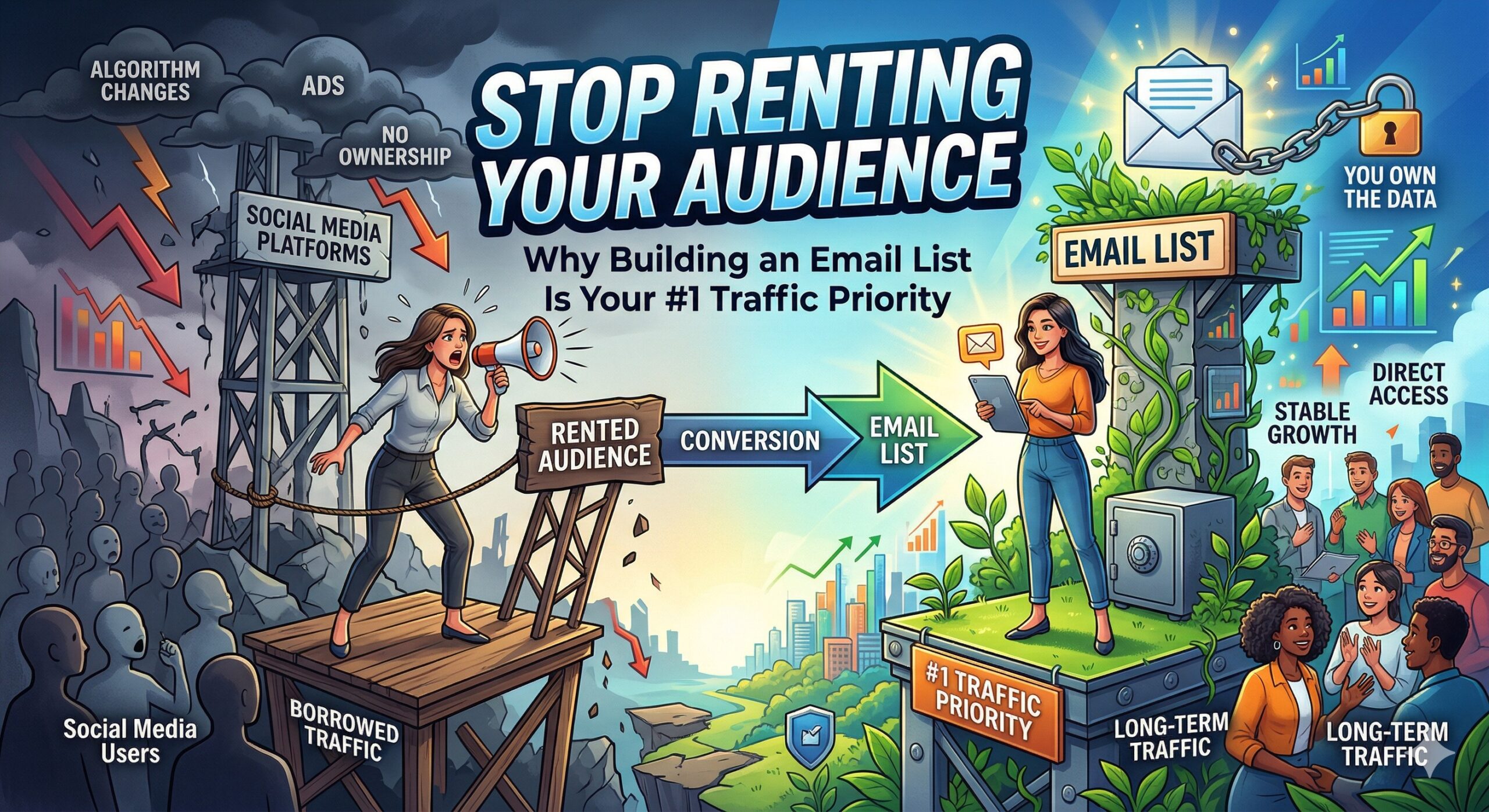
Most of the traffic sources we rely on as affiliate marketers — Google, TikTok, Instagram, Facebook, Pinterest — are rented. We don’t own those audiences. We’re tenants. The platform owns the relationship, and the platform can change the rules at any time.
Search rankings shift. Social algorithms throttle organic reach. Platforms get acquired, deplatformed, or simply change their content policies. Any one of these events can cut your traffic overnight through no fault of your own.
69% of affiliate publishers in 2026 say Google algorithm changes and AI Overviews are already reducing their traffic. Building an owned audience is now described as a survival strategy, not a bonus.
An email list is different. You own it. When someone gives you their email address, that relationship belongs to you. No algorithm can take it away. No platform update can bury your content. You can reach your audience any time you choose, directly in their inbox.
💡 Steven’s Tip: Think of your email list as the one piece of digital real estate that is truly yours. Every other traffic source is borrowed. Your list is owned.
The Numbers That Made Me Pay Attention
I’ll be honest — for a long time I assumed email was old-fashioned. Social media felt exciting and dynamic; email felt like something your accountant used to send invoices. I was wrong about that.
Email marketing delivers a return of $36 for every $1 spent — a 3,600% ROI. Nothing else in digital marketing comes close to that. And with over 4.7 billion daily email users projected by the end of 2026, the audience hasn’t gone anywhere.
What’s more, email subscribers convert at a significantly higher rate than traffic from social media or search. The reason is simple: someone who has actively given you their email address and consented to hear from you is already warm to your recommendations. They know who you are. They trust you at least enough to let you into their inbox. That’s a very different relationship to someone who stumbles across your blog post from a search result.
What You Need to Get Started (Less Than You Think)
The good news is that you don’t need anything complicated to start building an email list. Here’s the simple setup that works:
An Email Marketing Platform
You need a tool to collect email addresses and send emails. For beginners, I’d recommend starting with either ConvertKit (Kit) or AWeber — both have free plans and are built with bloggers and affiliate marketers in mind. (Full disclosure: I use Aweber and earn a small affiliate commission if you sign up through my links, but I’d recommend it regardless.)
A Lead Magnet
A lead magnet is something valuable you offer for free in exchange for an email address. It doesn’t need to be complicated — a one-page checklist, a short PDF guide, a resource list, or a mini email course all work brilliantly. The key is that it solves one specific problem for your ideal reader.
For a blog like mine focused on affiliate marketing, something like ‘The Beginner’s Checklist: 10 Steps Before You Launch Your First Affiliate Post’ would be a natural fit. What would work for your niche?
An Opt-In Form on Your Site
Once your email platform is set up and your lead magnet is ready, you add an opt-in form to your website. Most email platforms make this very straightforward. Place it prominently — at the top of your homepage, inside blog posts, and as a pop-up that triggers when someone has been on the page for 30 seconds or more.
💡 Steven’s Tip: Don’t make the mistake of only putting your opt-in form in the footer. Most readers never scroll that far. Put it where your readers are actually reading — inside the content itself.
What to Send Once People Sign Up
This is where a lot of beginners get stuck. They build the list but then feel paralysed about what to actually send. Here’s a simple structure that works:
- Week 1: A welcome email that delivers your lead magnet, introduces yourself, and tells people what to expect from you
- Week 2: A genuinely useful piece of content — your best blog post, a tutorial, a resource you’ve found helpful
- Week 3: A soft recommendation — introduce an affiliate product you genuinely use and believe in, with context about why
- Week 4 onwards: Continue the pattern of value-first, with occasional relevant offers woven in naturally
The golden rule is this: for every promotional email you send, send at least two or three that are purely helpful with no pitch attached. Trust is the foundation of email marketing, and trust takes time to build but seconds to destroy.
The Compound Effect of a Growing List
Here’s what excites me most about email list building: the compounding effect. A list of 500 engaged subscribers today might feel modest. But if you’re consistently adding 50 new subscribers per month, by this time next year you’ll have a list of 1,100 people who know you, trust you, and want to hear your recommendations. That is a serious asset.
The affiliate marketers who have stable, resilient income in 2026 are overwhelmingly the ones who invested in building their lists two or three years ago. The best time to start was then. The second best time is today.
💬 Do you currently have an email list, or is this something you’ve been putting off? What’s held you back — the tech, the content, or just not knowing where to start? Drop a comment below and let me know. I read every single one.